Workspace
The seven questions a theory of consciousness must answer
A complete theory of consciousness should answer “Yes” to all seven necessary conditions. Browse the questions, then see where each theory answers them and where it still has gaps.
Sign in to propose edits, add answers, or refine a theory’s verdicts.
The seven questions
View all questionsHow can subjective experience be accounted for in physical or computational systems?
Why does the subject of experience coincide with the initiator of action?
Does consciousness have causal efficacy within a system, beyond mere correlations or predictability?
How can differences in levels or states of consciousness be explained?
What functional or cognitive roles are associated with consciousness?
How can the diversity, structure, and organization of conscious contents be explained?
Can the theory be applied across different types of systems, including artificial systems?
Theory coverage
IIT
Integrated Information Theory (IIT) proposes that consciousness is identical to integrated information, quantified as Φ (phi). Developed primarily by Giulio Tononi and collaborators including Christof...
7 answers
GWT
Global Workspace Theory (GWT) proposes that consciousness arises when information is broadcast widely throughout the brain via a "global workspace." Originally developed by Bernard Baars in the 1980s ...
7 answers
HOT
Higher-Order Thought (HOT) theory proposes that a mental state becomes conscious when it is represented by a suitable higher-order mental state—typically a thought about that first-order state. Develo...
7 answers
PP
Predictive Processing (PP), also known as the predictive brain or predictive coding framework, proposes that the brain is fundamentally a prediction machine that constantly generates models of the wor...
7 answers
PCT
Perceptual Control Theory (PCT) proposes that behavior is organized around the control of perception rather than the production of outputs or responses to stimuli. Developed originally by William T. P...
7 answers
Orch OR
Orchestrated Objective Reduction (Orch-OR) proposes that consciousness arises from quantum computations in brain microtubules, with moments of conscious experience corresponding to quantum state reduc...
7 answers
Research map
Research map by Max Noichl & Moritz Kriegleder showing how 38,651 consciousness papers cluster. Use it to locate related sources while comparing theories.
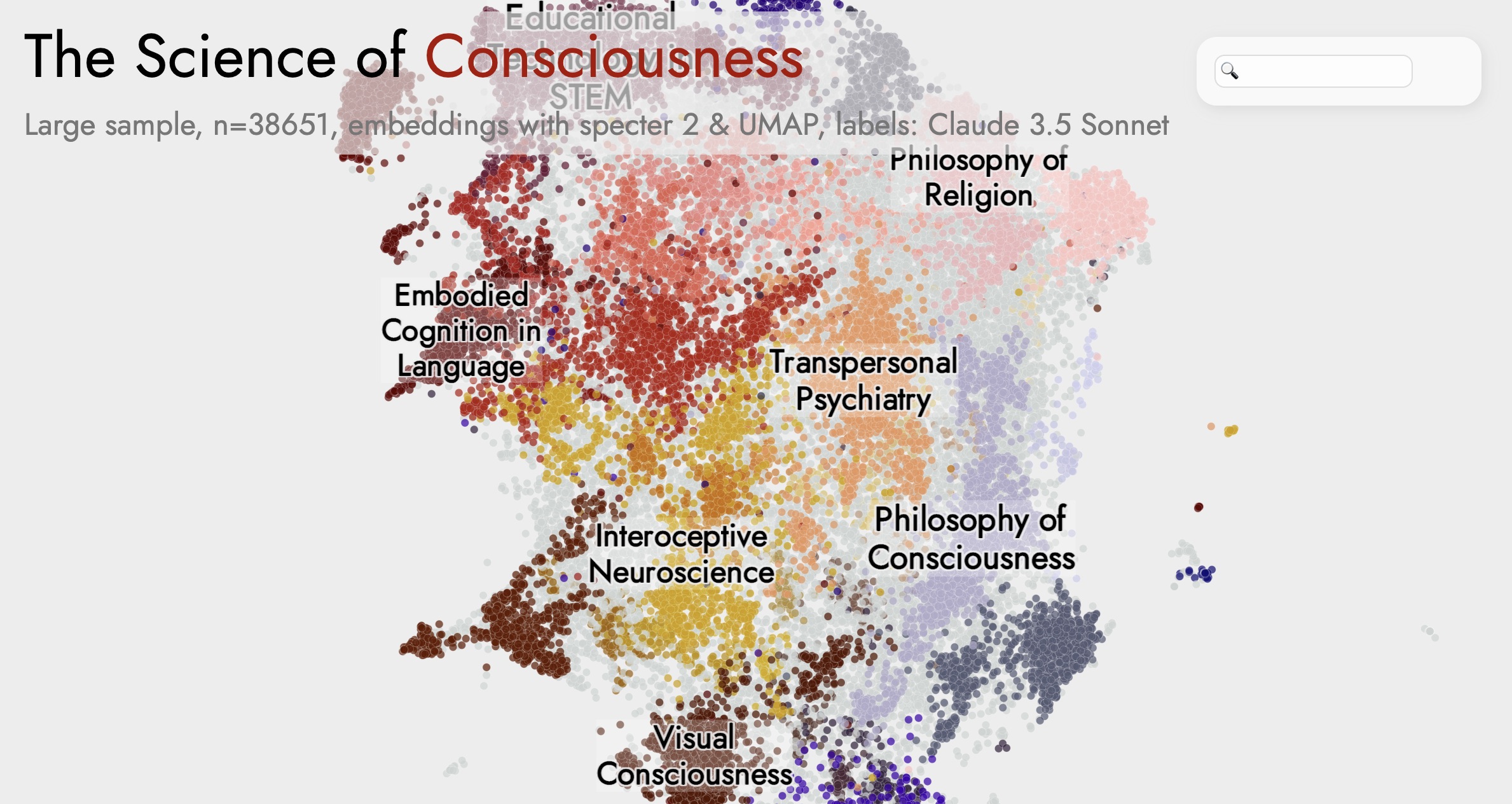
Research landscape map
Click to open the interactive version